
Satellite and space applications
Put optical observations for SSA, SDA and SST in context and support safe space operations.
Engineering task
Ground-based observations provide data on satellites and orbital debris. Scientific programmes and spaceflight safety services need comparable images with information about measurement uncertainty and observing conditions.
System concept
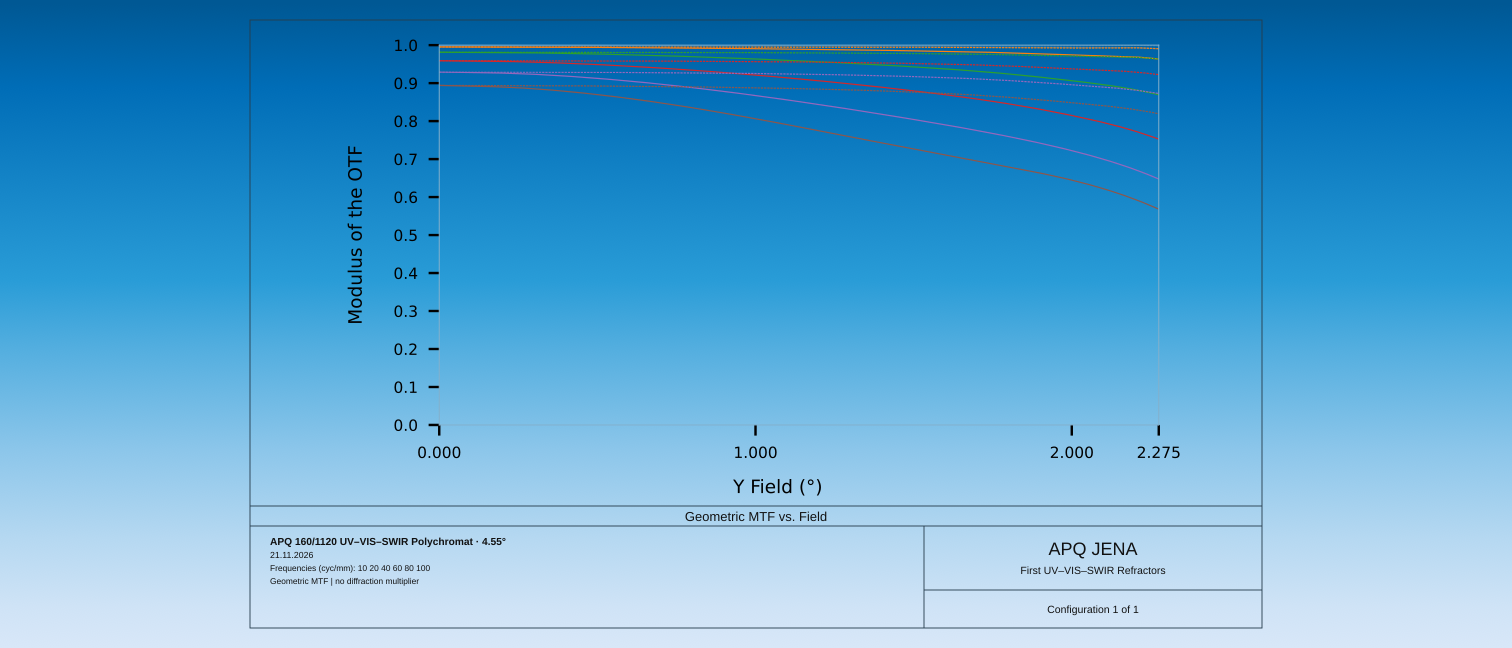
The APQ 160/1120 serves as an example of the optics in a wide-field instrument. The concept considers visible imaging and complementary spectral observations with suitable detectors for each band.
Operating scenario
Space Surveillance and Tracking (SST) uses sensor observations of artificial objects in Earth orbit. In the European programme, these data feed collision avoidance, re-entry analysis and fragmentation analysis services. Wide-field optics are one component of an optical observation station.
In the EU programme, Space Situational Awareness (SSA) is the broader picture that includes SST, space weather and near-Earth natural objects. In the security context, Space Domain Awareness (SDA) places the status, operation and dependencies of space systems into a wider picture. Optical observations can contribute to that picture.
Visible images form the basis of the observation record. Additional bands can add brightness profiles and spectral information. The data handover includes acquisition time, spectral band, calibration status and measurement quality.
Verification
Verification focuses on image quality, astrometry against reference stars and traceability of observation times and calibration. The results can support civilian research databases.
- Astrometric residuals against a reference star catalogue
- Repeatability of observations and traceability of acquisition times
- Documented uncertainty for each observation and spectral band
Terminology references · EUSPA (SSA and SST) · U.S. Space Force (SDA)