
Wide-field astronomical photometry
Compare photometry of the same stellar field in selected visible and infrared bands.
Engineering task
An astronomical instrument needs to capture star fields in several bands. Comparable brightness measurements depend on consistent treatment of the field, photometric calibration and reference star positions.
System concept
For large-format SWIR instruments, APQ lists a Teledyne H4RG-15 HgCdTe variant with a 2.5 µm cut-off for the 160/1120. A separate visible channel complements the instrument. The shared optical design provides a starting point for matching the two channels.
Operating scenario
One example is multiband photometry of a stellar field. The visible channel provides comparison images. The infrared channel records the same stars through selected filters. Reference stars in the shared field link the brightness scales of the two channels.
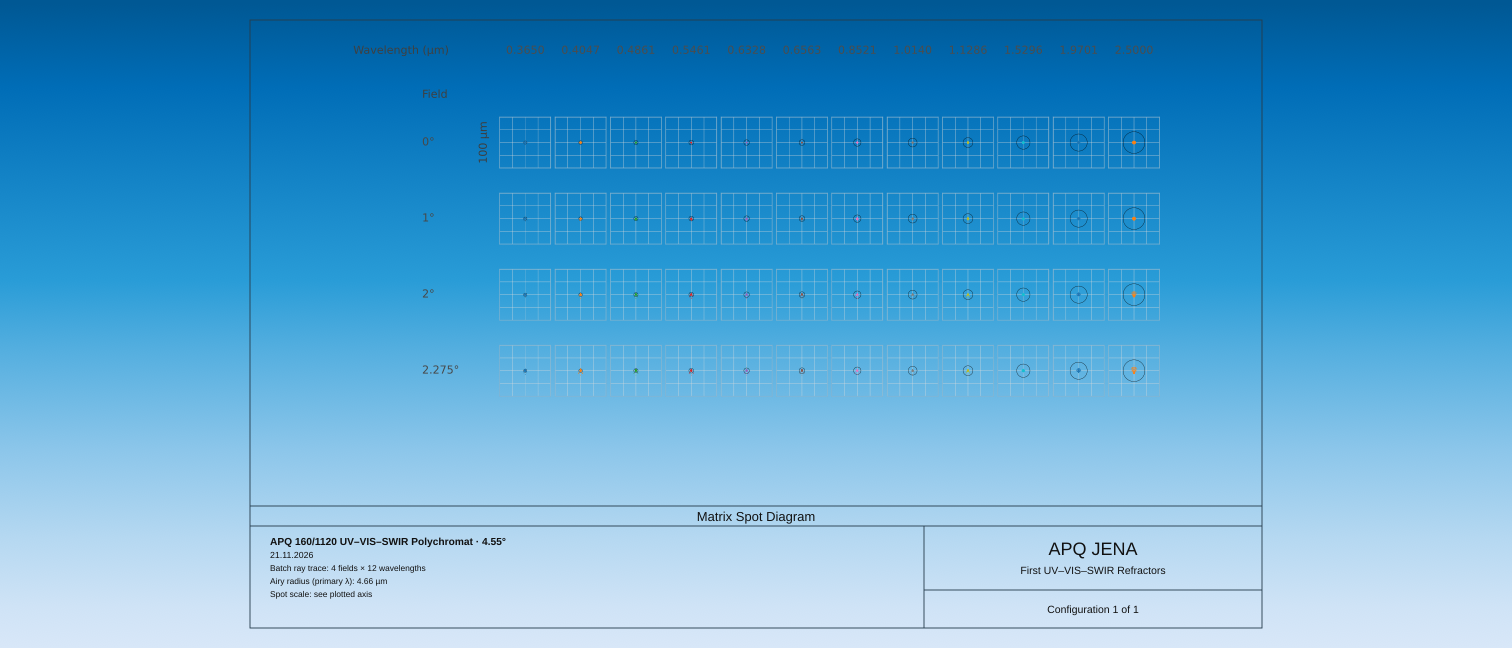
The analysis begins with point images at the centre and edges. The observing sequence accounts for dark signal, field sensitivity and sky background. Filter responses and atmospheric conditions are recorded for the comparison between bands.
Verification
Verification includes reference stars, dark frames, flat fields and a comparison of point images at the centre and edge. Photometric performance also depends on the detector, filters, sky background and observing conditions.
- Photometric scatter in independent repeat exposures
- Variation of point images and calibration residuals across the field
- Usable common field of view of the two detector channels